What Writing Girl Up India’s First-Ever Coffee Table Book Taught Me About Leadership
When I joined Girl Up India, I thought my job would involve meetings, spreadsheets, event planning, and the occasional PowerPoint presentation. I did not expect to spend the next year interviewing changemakers across continents, obsessing over fonts and margins, crying over beautifully worded interview quotes, and helping write Girl Up India’s first-ever coffee table book. Yet somehow, that’s exactly what happened. And honestly, I wouldn’t trade the experience for anything.
The project began with a vision from our Regional Director, Aditi Arora, who has spent more than eight years building, nurturing, and championing the Girl Up movement across India. She wanted Girl Up India to pause and reflect on the bigger story: What happens after Girl Up? How do the lessons, relationships, opportunities, and confidence built through the movement continue to shape a leader’s journey years later?
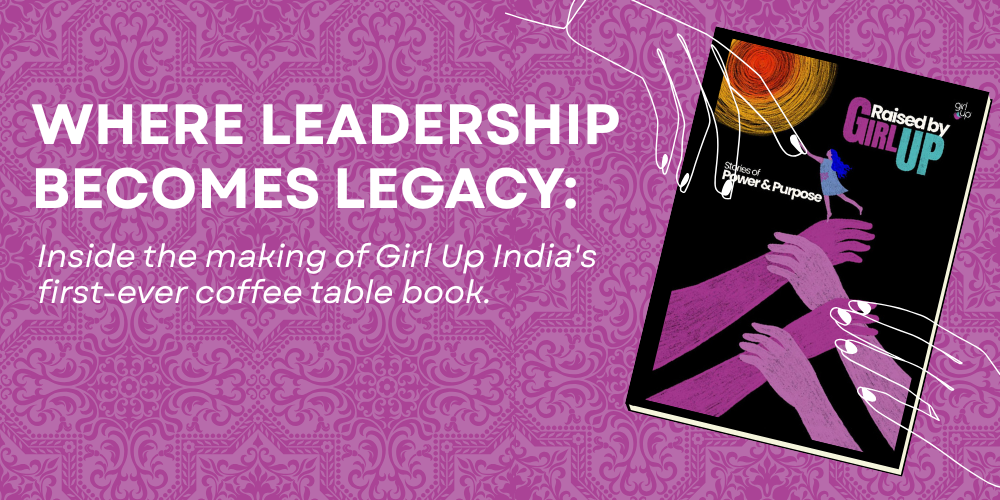
That question became the foundation of what would eventually become Raised by Girl Up: Stories of Power and Purpose. We knew our alumni were doing incredible things. Some were working in policy. Some were researchers, activists, entrepreneurs, creators, and community leaders. But we had never brought together these deeply personal leadership journeys in one place.
So, we decided to do something ambitious. We would tell the stories of eight extraordinary alumni through a coffee table book called Raised by Girl Up: Stories of Power and Purpose.
Simple enough, right? Wrong.
The moment we moved from idea to execution, I realized storytelling is equal parts inspiration and organised chaos. There were application forms to design. Participants to shortlist. Outreach emails to send. Calendars to coordinate across multiple time zones. Interview schedules that changed three times before finally happening.
Then came the interviews. And that was where the magic began. For hours, I listened to women talk about childhood dreams, impossible challenges, moments of self-doubt, victories nobody saw, and the people who helped them keep going.
Some conversations felt like leadership masterclasses.
Others felt like therapy sessions.
Many felt like both.
We knew from the outset that documenting Girl Up India’s legacy would be a complex and deeply thoughtful process. To learn from those who had walked a similar path, we connected with representatives from YWCA, whose experience proved invaluable. Our conversation not only helped shape our approach but also introduced us to a fascinating participatory storytelling method called Photovoice.
Through Photovoice, participants were invited to bring a photograph that symbolized their leadership journey. What I initially assumed would be a simple icebreaker soon became my favourite part of every interview. Each photograph unlocked memories, emotions, and stories that may never have surfaced through conventional questions alone. It transformed our conversations from interviews into deeply personal reflections, offering a powerful glimpse into the moments, people, and experiences that had shaped each leader’s journey.
A photograph of a stage became a story about finding confidence. A picture from a campaign became a story about resilience. A seemingly ordinary image became a doorway into years of growth, heartbreak, courage, and purpose.
I learned that leadership rarely looks the way LinkedIn makes it seem. It’s messy. It’s deeply personal. And sometimes it’s simply choosing to keep showing up.
Then came the writing. If you’ve ever tried turning hours of conversation into a compelling story, you’ll know it feels a little like solving a puzzle while blindfolded. Each interview contained dozens of powerful moments. The challenge wasn’t finding good material. The challenge was deciding what to leave out.
How do you fit years of growth into a few pages? How do you capture someone’s voice without losing its authenticity?
I spent weeks reading transcripts, identifying themes, chasing follow-up details, rewriting introductions, and trying to uncover the emotional thread that connected each journey back to Girl Up. But this was never a solo effort. Aditi was deeply involved at every stage of the process, bringing both the long-term perspective of someone who had spent years building the movement and the editorial eye needed to shape each story.
Every profile went through multiple rounds of review, discussion, and refinement. We would go back and forth on everything from structure and narrative flow to the smallest details that could better capture a leader’s journey. Aditi constantly challenged me to go beyond simply documenting achievements and instead tell the deeper story of growth, purpose, and impact. Those conversations pushed each profile to become more thoughtful, nuanced, and authentic than it would have been otherwise.
And just when I thought the hard part was over, the design process began.
Suddenly, I had opinions about typography. I found myself discussing colour palettes, illustration styles, page layouts, alignment, margins, and visual storytelling with a level of enthusiasm that surprised even me.
Somewhere between reviewing draft designs and debating tiny formatting details, I realised this project had quietly become much bigger than a book.
It had become a documentation of impact.
A celebration of diverse leadership.
A reminder that change doesn’t always happen on global stages!
Sometimes it happens in classrooms.
Sometimes in communities.
Sometimes in conversations.
And sometimes in young people who are simply given the chance to believe in themselves.
The most rewarding part of the process wasn’t seeing the final pages come together. It wasn’t even seeing ‘author’ written next to my name on the back cover. It was the fact that while documenting stories of these Girl Up girls….I too became a Girl Up girl!
None of these leaders followed the same path. They came from different backgrounds, identities, regions, and professions. But every single one of them had experienced the power of community. They had found people who believed in them before they fully believed in themselves. And that, perhaps, is the real story of Girl Up India. Not just building leaders. Building ecosystems where leadership can thrive.
When we finally launched the book at the Leadership Summit in December’25, it felt surreal. Months of interviews, writing, editing, reviewing, designing, and re-reviewing had somehow transformed into something tangible.
A book. A legacy. A collection of stories that will hopefully inspire many more.
As a relatively new staff member, I thought I was documenting the journeys of eight leaders. What I didn’t realise was that the project would shape my own journey too.
This book may be called Raised by Girl Up. But if I’m being completely honest, I think it raised me a little as well.
Author bio
Pratishtha works as an Associate with Girl Up India. When she’s not working, you’ll find her on a stage talking about disability inclusion , mental health, and gender justice.