My first experience with Girl Up was discovering a global movement that finally felt like it spoke to me and for me. I was drawn to its unapologetic commitment to equity, girl leadership, and social impact. That resonance quickly turned into action when I founded and began leading Girl Up Morocco.
Since then, I’ve engaged with Girl Up through club leadership, campaign organization, and regional mobilization. I’ve had the opportunity to lead national initiatives, mentor younger activists, and represent Morocco within the broader Girl Up network. Our chapter became a space where girls felt seen, heard, and empowered to lead on issues from gender-based violence to education equity.
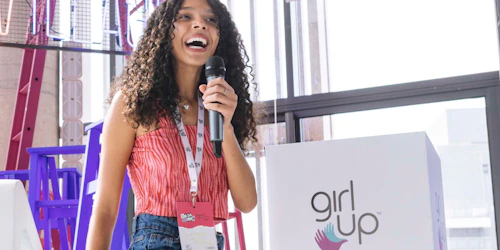
A transformational moment came when we launched our national speaking series, a platform designed by girls, for girls, covering topics ranging from STEM and sports to mental health and gender equity. We brought together girls from across Morocco to speak, listen, and learn from each other. It wasn’t just about sharing stories, it was about breaking silences, building confidence, and showing girls that their voices have power. Watching them connect, speak up, and realize their collective strength reminded me why this work matters.
Girl Up has reshaped not just what I want to do, but why I want to do it. It taught me that leadership isn’t about being the loudest in the room; it’s about creating space for others to rise with you. That belief now guides every decision I make, whether in school, in my community work, or on a national level.
Since starting with Girl Up, I’ve pursued initiatives centred on youth empowerment, STEM education for girls, and policy advocacy. My goal is to continue building systems that serve rather than silence. I hope to take this work into global policy spaces, combining grassroots insight with institutional change.
One project I’m particularly proud of was renovating a high school classroom in Safi, transforming it into a welcoming space where girls who live far from school could rest during long breaks, study in a quiet environment, and simply feel safe. For many of these students, the lack of a supportive space was a barrier to both learning and wellbeing. Creating this room wasn’t just about infrastructure; it was about dignity, access, and investing in girls’ right to learn in peace.
In a different part of our work, we organized a Sports Day and football tournament for girls, with the goal of challenging gender stereotypes and encouraging girls across Morocco to pursue their passion for sports. For many participants, it was their first time playing football in a public, all-girls setting. The energy, confidence, and solidarity that came out of that day made it clear: when girls are given space to lead, whether in classrooms, on fields, or in society, they rise.
Girl Up has shaped my perspective on justice, not just as an abstract value, but as a daily practice. I now understand leadership as a form of service, and feminism as both an identity and a responsibility. I lead today because others before me created space, and now it’s my turn to do the same.
Girl Up has shaped my perspective on justice, not just as an abstract value, but as a daily practice.
To me, being a leader now means listening deeply, acting boldly, and staying accountable to the communities you serve. It means knowing when to speak, and when to pass the mic. In the next 15 years, I hope Girl Up continues to evolve as a platform that centers voices from the Global South, challenges power structures, and redefines leadership through inclusion and care. I want future Girl Up leaders to see no limits to what they can imagine or achieve.
If I could give my younger self advice, I would tell her this: You don’t need permission to lead. Your voice matters, not despite where you come from, but because of it. Be loud. Be kind. Be relentless.