Dear Latin America,
Today, I write to you to applaud.
But also to breathe.
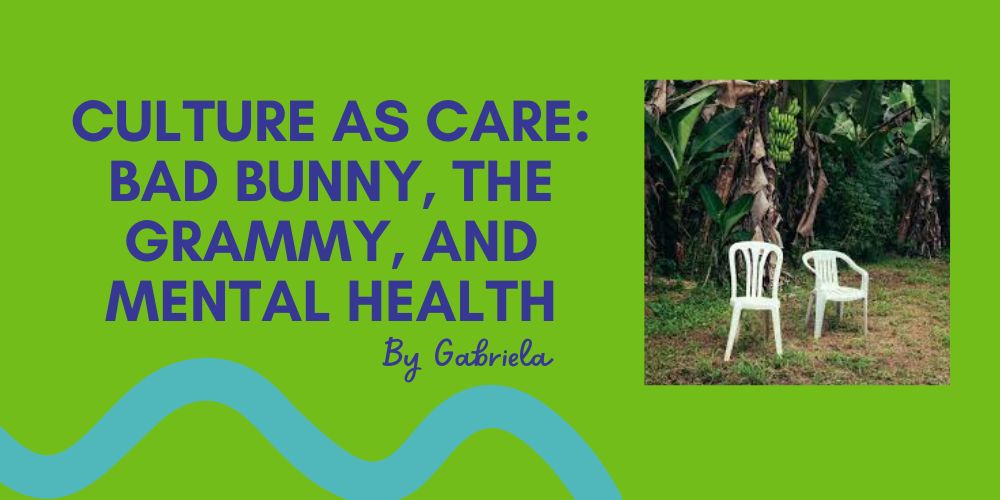
Two plastic chairs on the album cover.
Simple. Worn. Ordinary.
The same ones we place on the sidewalk
when the mind feels heavy
and the body asks for a pause.
Because here, mental health was never a clinic —
it was always conversation.
It lives in corner bars,
on front porches,
in the quiet invitation to sit for a while
so we don’t fall apart alone.
This album understands that.
It sounds like memory,
like longing,
like trying to hold onto something already slipping away.
As he says:
“Un verano sin ti no es verano.”
And it isn’t.
Because loss — of people, of home, of belonging —
also wounds the mind.
Absence becomes anxiety.
Nostalgia turns into a knot in the chest.
Each song feels like a collective confession,
a way of naming the emotional exhaustion
of a generation that loves its culture
while carrying the weight of surviving within it.
Bad Bunny gives language to what so many feel
but were never taught how to say out loud:
emotional exile,
identity under constant negotiation,
the mental toll of existing while being watched, judged, threatened.
And when he speaks about ICE,
he is also speaking about trauma.
About chronic fear.
About hypervigilance.
About minds shaped by the constant possibility
of being taken from home without warning.
That is mental health, too.
Even when the world refuses to call it that.
You cannot celebrate Latin music
while ignoring the psychological cost of being Latin.
You cannot dance
without listening to what is being said beneath the rhythm.
This album does not romanticize suffering —
it validates it.
It says: you are not imagining this.
And for many, that recognition is already a form of care.
Latin America,
those two chairs are not just aesthetic.
They are an improvised safe space.
A place where pain is allowed to exist without correction,
where exhaustion is not mistaken for weakness,
where simply being alive is an act of resistance.
And if this album won a Grammy,
maybe it’s not only because of its sound,
but because, for a moment,
it sat with us on the sidewalk
and listened.
And sometimes,
what protects a people’s mental health the most
is exactly that:
being seen,
being named,
being heard.
Let’s turn our streets into places of true listening.
Let’s make our conversations safe harbors for emotion.
Let’s write a new collective story — one where vulnerability is strength,
where listening builds bridges,
and where culture becomes care.
If you are struggling in silence, know this: you are not alone.
Your pain is real, and it deserves to be heard.
You deserve support. You deserve to understand your feelings
and find paths toward healing.
Let’s stop whispering and start speaking together.
Let’s turn our pain into poetry, our struggle into strength,
and our history into a shared story of dignity and hope.
With love and solidarity,
Gabriela